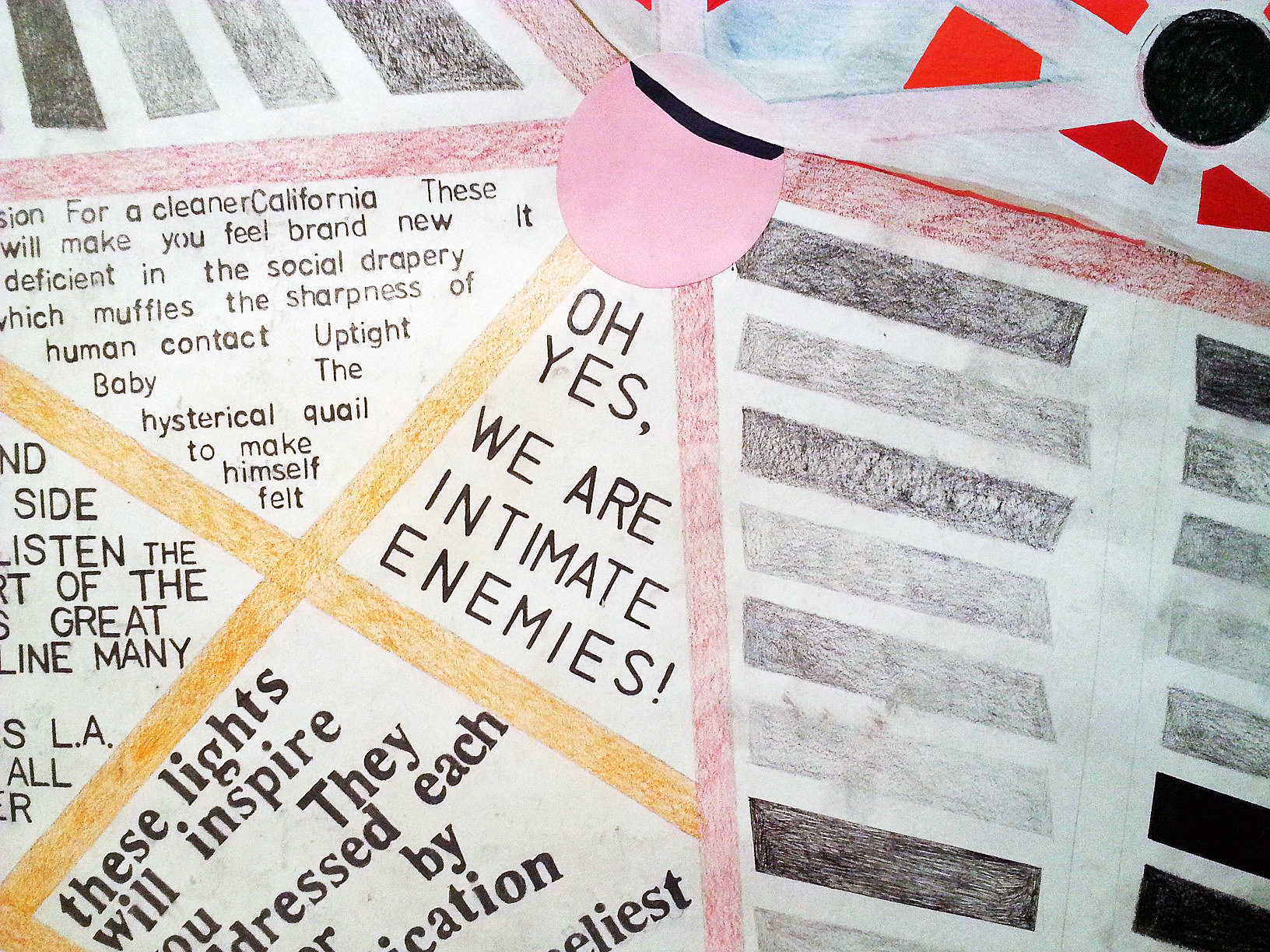
"Gender Is the Extent We Go to in Order to Be Loved"
1. Sex Change and Trans Studies
The premise that makes trans studies possible is the thesis that sex can change.1
I take sex to mean the signification of sexual difference — the fact of sexual difference pressed at every point into social meaningfulness.2 From this perspective, sex is an ideological abstraction with material force. In the debates that define trans studies, materialism and materiality are themselves fraught terms of engagement — Kathleen Stock, for instance, thinks that “material” belongs to the anti-trans camp.3 When I say material I mean it in the Marxist sense of pertaining to the production of social reality, a reality that is lived, thought, and felt, that moves people to action or locks them in place, and that determines, though not absolutely or unchangeably, the contours of their lives. Materialism is a dialectical term that helps us to comprehend how actually existing reality already contains in motion the forces that have transformed and will transform it, down to its elements that seem, to some, untouchable constants, like sex.
People can change sex; they do it all the time. At the same time, sex, an abstraction with social force, can and does change, indeed, is changing, like history, under our feet, through a collective and constant pattern of agency and determination, of what we allow, and what we do, and what we discover, and what we suppress, and what we coerce out of each other, and what we think to be possible and make possible. In this essay, I’ll argue that the object of sex change is the durable transformation of relationships between self and other, mediated by the body, and that the social meaning of sex change derives from the sexual division of labor. The transformation that sex change is supposed to effect is, in this sense, only incidentally a transformation of the flesh, though incidentals matter a lot. It is a transformation of a series of relationships of recognition, of self to self and self to other. Recognition, too, offers a framework for coalitional organizing for trans liberation across constituencies of poor and working people, most of whom are not and are not likely to become trans, but can under the right circumstances join in a collective fight for a materially secured sense of dignity, which is also a recognition relationship. People seeing each other as those through whom they can and must win a livable life, and therefore learning to see each other in the terms of one another’s dignity and sense of self-worth — these are the principles of establishing a political coalition, of people learning to think and act together as a broad political constituency.
I want to emphasize the salience of this claim, “the premise of trans studies is the thesis that sex can change,” in four different ways. First, the anti-trans right fully rejects it. They take themselves to be the defenders of sex. They think that our object is “gender,” which is something fake and willed, whereas theirs rests in the dignity of fact. And that fact might be dignified by the body, or by chromosomal sex — their version of determination in the last instance — or by a particular conception of God, or by their piercing, and as far as they’re concerned, punishingly correct intuition about who is and is not a transsexual.4 But whatever basis they attribute to their position, they are fast in their conviction that sex cannot change, all the while furiously attempting to coerce a social reality in which it is less and less possible for people to take the kinds of measures that assist in its changing.
Second, the social abstraction that trans studies is primarily trying to understand is not actually trans people, it’s the differential category of sex. And by that I don’t mean to oppose sex to, or elevate its causal primacy over, other dimensions of social difference. I mean that as part of a large and ultimately cohesive science of understanding the world in order to change it, trans studies is oriented toward comprehending the subjective dimension of the sexual division of labor over time and place as one of the motor mechanisms of a highly unequal society, of the inequalities it requires to function, and of the forces that ultimately transform it. In that sense, the sexual division of labor doesn’t just include the color line; it’s one of the mechanisms that gives force to, indeed is required by, the “state-sanctioned and extralegal production and exploitation of group-differentiated vulnerability to premature death,” as Ruth Wilson Gilmore defines racism.5 So in concrete terms if we want to understand what makes it possible or likely for some people but not others to die in childbirth, or to die turning tricks, or to die making garments — in Manhattan in 1911, or in Bangladesh in 2013 — or to die while riding a delivery bike, or to die in prison, then the intervention that trans studies makes is to ask how everyone, absolutely everyone, decides and desires to live under the pressure of the overwhelming and constant force of the changing same of this social division. We want to know how people make sense of a wrong and bad world to themselves, how they structure their relationship to it, what makes being in relation to the world and each other bearable or not, and this will force us to take seriously the materiality and material transformations of sex. The fact that sex lives in consciousness, consciousness that gives meaning to flesh, implies that people apply their energy, activity, agency, and creativity to it constantly, even if only to its upkeep.
Consciousness that gives meaning to flesh: Rosemary Hennessy refers to this dynamic as the “second skin of social identity,” by which she means the mediations that constrain everyone’s expectations of the kinds of lives they and others might reasonably live, which is also to say the kind of work that they will likely do, the social protections they do or don’t enjoy, and the forms of coercion to which they might legitimately be made subject.6 I mean consciousness, then, in the sense of the developing relationship of subject and object: what people think reality is, how they arrive at a sense of themselves through the understanding that others have of them, what they believe stands in their way of a life worth living, what can be done about it, and with whom it is possible to act. Consciousness shapes and animates the inequality of any unequal society, as people en masse legislate the terms on which social life is lived. As I’ll emphasize below, consciousness is therefore also the mediation through which sex change becomes meaningful, as people attempt and succeed in achieving different forms of recognition through specific, targeted interventions that affect perception of this “second skin.”
Third, I want to flag in advance that my categories don’t map onto the framing of sex and gender that Maya Gonzalez and Jeanne Neton use in their essay “The Logic of Gender,” initially published anonymously a decade ago and attributed to the Endnotes collective.7 In their essay, Gonzalez and Neton lock sex and gender into an analogy with, respectively, use- and exchange-value; for the authors, gender is the abstraction of sexual difference, sex its concrete manifestation, and the “gender fetish” their name for the ideological obfuscation that makes difference appear natural. In my 2020 essay “Gender as Accumulation Strategy,” I critiqued this framing for evacuating the subject — the intimate scale on which the sexual division of labor does its often deadly work.8 Without the subject, you cannot actually talk about the fact that people change sex, and you cannot talk about why.
In my approach, which follows what I think of as Oren Gozlan’s crisp rendition of the concept, gender is a symptom — the fingerprint that the symbolization of sexual difference leaves on the subject, one by one by one.9 When we talk about symptoms, we can talk of loving and enjoying them, and we can talk of their perverse effects. And I think this gives us more conceptual amplitude than Gonzalez and Neton make possible in their strict definition of gender as the “anchoring of individuals into separate spheres of social activity,” which more or less creates an identity between gender on the one hand and the sexual division of labor on the other, and therefore underlies their speculative orientation toward what they call gender abolition. But from my perspective, this is a category error: if gender is a symptom, then the speculative aim of even a radical science of sex and gender is not actually abolition. You don’t abolish a symptom. You don’t even cure it.
But fourth, trans studies, like Marxism, does in fact have a speculative aim. We are trying to change sex. More specifically: we are aiming to understand a world in order to change it, specifically, in this case, because we think that sex change is an overall good, and that people who change sex, like all people, deserve dignified lives. People should change sex, if they want; sex change should be casual, easy, and universally accessible; it should, in fact, mean less, and mean something other than what it does now; sex as a punitive ordering mechanism of bourgeois society should change, probably, in its desperate entirety. So part of the right-wing slander is in fact correct, insofar as we are in fact trying, here tipping my hat to Jules Gill-Peterson, to “bring our kids up trans,” in the sense that one consequence of our political success would in fact be that more people change sex in durable ways with low stakes for individuals and mass cumulative social effects.10 Trans studies is therefore a theory of change — both in the empirical sense that organizers use to describe how social life becomes other than what it is, and in the speculative sense that makes knowledge into a force for transformation.
2. The Sex-Change Division of Labor
From this perspective, I want to excavate what I think of as both a core and a largely unthought element of sex change, one that has tremendous effects for what we think of as the trans political project. I want to approach this element of sex change by making use of an extraordinary paragraph by an author who is not a transsexual. The paragraph comes from the novel Margery Kempe, by Robert Glück, which is where I took the title for this essay.
Glück wrote Margery Kempe in the early ’90s. The first edition came out in 1994 from Ira Silverberg’s and Amy Scholder’s High Risk Books, and NYRB Classics reissued it in 2020. It threads together a retelling of the life of Margery Kempe, a fifteenth-century failed saint from Norwich, UK, who wrote the first autobiography in the English language and believed that she was the bride of Jesus, with Glück’s own failed relationship in the late ’80s and early ’90s with a man from the ruling class, identified only by the letter L. In this novel, Glück passes — not seamlessly — between the fifteenth and the twentieth centuries. You could say he leaps between them, but lingers in the fifteenth. For instance:
A horse was hag-ridden. Its owners filled a bottle with its urine, stopped it with a cork, and buried it: the witch could not piss and died in agony. The air hummed with flies when the travelers approached the cattle — rich odors of dung and hay. They heard an ouzel’s ringing tew tew tew; the peasants cupped their ears. Farmers tilled their small fields to the limit. Women carded and combed, clouted and washed, and peeled rushes as in Lynn. One woman became a man when he jumped over an irrigation ditch and his cunt dropped inside out: gender is the extent we go to in order to be loved. His mittens were made of rags.11
Glück’s medical miracle comes from a fable recorded first in Ambroise Paré’s 1573 book of medicine Des monstres et prodigies, which relates the story of an old swineherd named Germain. At 15, Paré says, Germain, then named Marie, chased a pig into a wheat field. The pig passed over a ditch. Leaping over it, Germain “ruptured his ligaments” and his “genitalia and male rod” fell out of his body. Assembled physicians pronounced him a man, no longer a girl. The anecdote then appears in Montaigne’s 1580 essay on imagination.
Glück’s sentence produces an unparalleled insight of transsexual subjectivity, in which sex change orbits the impossible recognition relationship of love. In that sense, gender writes and rewrites the answer to the question “as what and who can I be fucked,” which is to say that gender is a fantasy of being held durably in regard by others. Fixated on “identification,” the political right and center both mistake the content of the fantasy, which is to be identified: less willful voluntarism, more a compromised expression of agency that ideally rests on the agency of others. While it’s easiest to notice in the case of sex change, the fantasy is universal. It exerts immense pressure on people of all kinds, who twist themselves into extraordinary directions to be regarded in a way that they can bear, and who experience sometimes incapacitating humiliation if that regard bends even minimally beyond an acceptable range.
“Gender is the extent we go to in order to be loved”: In Glück’s pithy formulation, gender names a desire for desire. In his paragraph, even acknowledging the libidinal charge of gender loosens something in the tight knit of social constraint. The marvelous sex change that Germain experiences at the end of the paragraph inverts the witch’s death at its start; the tight seal on the bottle breaks in Germain’s cunt that “drops inside out.” Glück’s phrase cuts like a fence or a ditch through a field of other sentences, most of which are about either work or poverty. “His mittens were made of rags,” “Farmers filled their small fields to the limit,” “Women carded and combed, clouted and washed”: the sexual division of labor sets the stage on which Germain’s miraculous transformation takes place. Newly a man, Germain is poor; the peasants around him have lots no less meager. Historically speaking, soon they won’t even have those. Why was he chasing a pig, and why did he have to leap a ditch into a wheat field to get it back?
In an essayistic poem about Germain that Andrea Abi-Karam and I published in We Want It All: An Anthology of Radical Trans Poetics, Rowan Powell records that the centuries-long process of enclosure that spilled peasants from their subsistence plots and created a proletarian class in northwestern Europe divided places through hedges, fences, ditches, stone walls, and other boundary markers.12 The field belonged to someone else, and the ditch marked the difference. Banal divisions indicate great transformations in the death and life of private property. The libidinal release that follows the sex change in Glück’s paragraph is part of the same process as the enclosure of the commons. “They hang the man and beat the woman / that steals the goose from off the common,” goes a traditional English protest song of the period, “but let the greater villain loose that steals the common from the goose.” Glück sets his novel in a period of great historical transition: “Margery lived during the Hundred Years War, the collapse of feudal systems, and the plague,” he writes. “At the beginning of modernity the world and the otherworld lay in shambles.”13 Transsexuals are not the harbingers of great social upheaval, whatever doctors, medical historians, or the architects of moral panics think. We’re making the most of an impossible situation.
3. Recognition, Fantasy, Fulfillment
Glück’s paragraph, which makes sex change meaningful from the point of view of the regard of others in context of a historically determinate sexual division of labor, shapes an insight about what it means to change sex. Consider the following thesis: the actual object of sex change is the durable transformation of relationships between self and other, mediated by the body, where the body here is understood to be social at every point, and thus to belong in a Lacanian sense — as Gayle Salamon and Judith Butler have argued — to the Imaginary, not the Real.14 Salamon argues that the body “as it exists for me” is a psychic construction that brings matter into a coherent structure, understood as self rather than other; “it only comes to be once the ‘literal body’ assumes meaning through image, posture and touch.”15
In other words, the point at which the body has social meaning is the point at which one is recognized or misrecognized — the point at which it assumes its “second skin” of social identity. In this sense, sex change is only incidentally a transformation of the flesh — what Salamon calls the “literal body.” Because the real thing that sex change does is durably transform a series of relationships, of self to self and self to other, the actual patterns of the regard and recognition that other people have are an underthought and indispensable element of what it actually means to change sex. The desire of the Other plays an outsized role in sex change; it has to. The dominant mode of understanding sex change has been to examine what people do to themselves, all while effectively bracketing the much more chaotic, complicated, and vast though ultimately predictable dimension of the regard of others.
All of which fits, ultimately, with the framing that I began with: I’ve already argued that trans studies is oriented toward understanding labor, toward understanding the metabolic transformation that agents and the world exert on each other, and the social dimensions that in a society rigorously kept unequal divide and secure it. And on the other, I pointed attention toward the intersubjective dimension of regard of self and other that sustains a collective, divided relationship to labor. Amy De’Ath names this dynamic one of “hidden abodes and inner bonds”: a dialectical process whereby the system reproduces itself through the production of subjective positions, of people who can express the logic of capital through their activities, and who, shaped into subjects, act out and sometimes try to understand their own desires as a countervailing force.16 Which is all to say that if we want to understand where transsexuals come from and what they (we) want, we have to confront the problem of recognition in trans politics. Recognition, in Lauren Berlant’s formulation, is the misrecognition you can bear.17 What is the role of recognition in the trans political project, and what are the stakes of placing it at or near the center of what we do?
In one sense, the stakes of recognition in trans liberation are simply coming to terms with the role of recognition in establishing life trajectories — the role of consciousness in contesting the price of one’s labor, and guiding expectations for the work that someone may legitimately do and the coercion that she might legitimately experience. Legitimation here is key: if, as Michael Denning’s reading of Gramsci suggests, people en masse legislate the terms of social life, then the kinds of lives that we collectively allow ourselves and others to live are at least in part the result of what people collectively experience as bearable or not.1819 In her interview with the NYC Trans Oral History Project, Cecilia Gentili illuminates the assigning of value that sets the terms for trans life in the Argentina of the 1980s and ’90s. Referring to the woman who coached her into transition, Gentili says, “She said well, if you want to be like me, you need to know that you’re going to be a whore, you’re going to get high, and you’re going to die young. And I said where do I sign? This is what I want.”20 As M.E. O’Brien points out in her 2021 essay, “Trans Work: Employment Trajectories, Labour Discipline and Gender Freedom,” fighting over the results of particular forms of recognition means that non-passing trans people most often struggle over work and its conditions, its indignities and humiliations.21 O’Brien’s essay, written before the latest terrifying round of the anti-trans panic, notes that “a majority of American employers can openly fire someone on the basis of being trans.” Getting clocked — the common parlance term for being recognized as trans — pushes people out of more secure and stable sections of the labor market, and into positions where they have to fight harder to subsist.
But the stakes of recognition for trans people pierce deeper still. To show you why, let me tell you a story: A woman and a man are fucking. They’ve been fucking for a while. He’s covered in sweat, and while he fucks her, with long, athletic strokes, sweat beads on his forehead, drops off and hits her in the mouth. They’re facing each other, but they aren’t looking at each other. He’s holding himself up by his arms, and he’s looking down at his cock sliding inside her and slipping out again. He looks at the tidy lips of her vulva, which envelop him, spit him back out and swallow him again. She’s looking at him looking down at her pussy, which she hasn’t always had, and she thinks about what he must be seeing and feeling: cock, lips, tissue, heat, and moisture, which, since she doesn’t lubricate very much, is mostly his spit. Fixated on this image, she comes harder than normal.
The moral of this parable is that recognition is a sexual fantasy. It is indelibly sexual. Changing sex, I arrive at a place where others see me as differently fuckable, or I want to, or that is the fantasy. The desire of the Other is, of course it is, sexual, which means that transition is a sexual desire, in a way that trans culture has dealt with more honestly than trans theory, since it seems somehow so pervy to acknowledge the fact that people change sex to fuck in a different and less unbearable way from how they might have fucked beforehand.
Some recent examples from the realm of culture: Torrey Peters’s Detransition, Baby — by far the most popular and highly purchased work of fiction by a trans writer — includes a vivid description of one character, experiencing awkward sex for the first time as a closeted teenager, imagining the sex she would actually like to have as a woman bottoming in a lesbian relationship, rather than the eggy, confused sex she is actually having. Gentili’s memoir, Faltas: Letters to Everyone in My Hometown Who Isn’t My Rapist, narrates a violent sexual encounter from her youth: “For many years I thought that I liked it. I have now come to understand that I didn’t like it. I needed it.” “He touched my nonexistent breasts as if they existed,” she writes a little later, “as if they were big enough to be squeezed.” Both Peters and Gentili make the experience of being understood sexually a core and inextricable part of sex change — but the sexual nature of recognition need not imply that an actual sexual encounter takes place. Each thinks about how the fantasy of being regarded in a particular way is a sexual fantasy that makes a particular subject position possible.
I’d like at this point to include a couple of caveats. One is that the point of the sex described here is not gender affirmation, and the purpose is not to advocate for a particular ethical position within sex. The woman in the story who climaxes thinking about her lover’s line of sight, how he manifests desire in his overwhelming urge to watch himself fuck her, isn’t getting off on being effortfully seen as a woman; it’s more like the fact that she doesn’t have to try is the precondition of sex being hot for her.
The second is that this form of regard is taken for granted by people who are not currently trans, who, by and large, though certainly not universally, experience the subjectifying force of sex without feeling its seams. If it’s a perversion to need to be fucked, or witnessed as fuckable, to gather a sense of yourself, then that’s everybody’s perversion, and if trans people spend more time thinking about how we are witnessed in sex, that’s only because of being more alive to the structures that define everybody else’s life too.
What happens if the man in question, realizing that the vagina he’s fucking was surgically rather than natally created, feels his desire suddenly invert into disgust, and confronts his lover by saying, What the fuck are you, I’m not a fucking faggot? Or — to take a horrific example from the news — consider the case of Tarjit Singh, a trans man in the UK convicted in 2021 of sexual assault for not disclosing his trans status to his lovers. These types of outburst, in which somebody senses that they’ve been brought, as they understand it, into contact with homosexuality and turns disgust with themself into disgust with their lover, who can be framed as the one at fault, is an example of what I mean when I say that sex is the social reality that emerges from everybody’s symptom, and transsexuals just do a better job of noticing it.
What does it mean for the sexual relation to function as the beating heart of recognition? One consequence of this thesis is that it puts a bomb in the middle of the exsanguinated, hygienic, liberal rendition of trans politics, and the bomb is sex. The lie of liberalism is that sex change is not sexual. And confronting this lie honestly does actually carry some significant risk, since the moral panic led by the political right takes sex change to involve predatory sexual content, framing sex change as a result of sexual predation that leads to more sexual predation. Thanks to Christopher Rufo — who piloted the Critical Race Theory panic and then with great calculation lifted the phrase “grooming” from QAnon and turned it into a slander against teachers who support trans students — rightists spread the lie that children who are not trans are being “groomed” into sex change. They also claim that trans youth, and indeed trans adults, pose a sexual threat to other young people.
In the present environment, where the sexualities of actually existing trans people form the absent center of the political fracas, it feels fraught to be open about the sexual content of transition — the fact that the desire to rearrange the sexed signification that structures one’s life not only carries implications for who and how one fucks, the capacities in which one could be understood to be a sexual subject, but also in fact itself carries a libidinal charge, like most prohibited desires do when prohibition slackens a little. Infamously, sex change is hot. Disavowing the sexual nature of transition is a political dead end to the precise degree that it is a denial of such a naked and ordinary fact.
4. Sex Change and Organizing for Dignity
So where does this leave trans politics, if repression is not an option, and failure to repress tempts a frontal fascistic attack? If sex change forms the hot core of trans politics, then in what sense is trans politics part of a liberation tradition with real stakes for the lives of people beyond an admittedly numerically small minority? In the understanding I’ve advanced here, trans politics depends on sexual liberation, on demanding and enforcing the ability of people to feel, express, and act on desires that make life worth living. So we can ask with clarity here: in what sense is sexual liberation also class politics, and how is it possible to form a coalition based around sexually informed desires that a large majority of people do not have?
To think through this problem, I want to draw on a principle from labor organizing. As Jane McAlevey and Anthony Thigpenn have emphasized, labor organizing is a form of structure-based organizing.22 Its strength comes from uniting people already brought together into a structure — a workplace, a building, a neighborhood, an electoral district — around a shared program. That is to say: structure-based organizing doesn’t begin from the principle that its constituents are already ideologically united. One key principle of this organizing practice is that people are often moved to action because they feel ground down or humiliated. They’re sometimes more likely to be moved to action if an organizer can help them identify the weight of the humiliation they’re already feeling than by all of the many real material deprivations of their lives — that is, people might be more moved to action through indignation at poor treatment than because of poor wages. This is the principle behind organizing for dignity. Dignity is a structure of feeling that is a pre-condition for political solidarity. It is the firm conviction that you and the people you don’t know deserve a life worth living, even if their lives are opaque to you.
There’s a scene in Stone Butch Blues by Leslie Feinberg that illustrates what I mean.23 Stone Butch Blues is a novel about labor organizing and butch-femme life in Buffalo, NY, before and after deindustrialization. It’s focused on Jess Goldberg, like Leslie Feinberg a Jewish, working-class butch who lived in Buffalo before moving to NYC. Jess, who has the respect of other butches she works with, and is sometimes either too quick or slow to action, is being sexually harassed at the factory where she works by one particular man with a normal gender, a petty bully. The factory is union, and the union throws a social gathering in the park for the workers. The men come, and the butches come. Jess’s antagonist goads her into a fight, and she responds by organizing a baseball game, cis men versus butches. Duffy, the union organizer, tries to talk her out of it, but at this point she’s fixed on her goal, which is in fact a gamble: she could cause needless conflict between two working-class constituencies, raise expectations among the butches that would then be disappointed, and humiliate herself further, particularly if her team loses; alternately, she could shift the organizing terrain for the entire union such that two constituencies in the union develop a mutual regard and trust that they previously lacked. The butches win, the men show them respect they hadn’t before, Jess’s antagonist loses the respect of his peers and their implicit tolerance for his bullying, and then Duffy agrees with Jess’s assessment: “The union did win today,” he tells her.24
This scene shows something about what I mean — something Samuel Solomon’s reading of literary labor in Stone Butch Blues in this dossier also demonstrates — which is that being able to claim dignity across class fractions, dignity experienced in mutual regard, clears the field for people to develop their power together. The cis men in the scene don’t need to arrive at a more profound understanding of gender on the other side of the fence in order to act better towards their fellow workers; they need structures within which to recognize the butches as part of a shared project.
And I think this is a helpful way of thinking about how sexual liberation does in fact relate to everyone’s problems. There is no way for people, transsexuals and non-transsexuals, to bear life in conditions of persistent misrecognition. And that is not, as the examples that have emerged in this essay suggest, an immaterial problem. It is a distinctly material problem, with dire consequences for life as it’s lived, eked, and pulped apart. Dignity is a classic working-class demand, and a classic organizing principle, that also forms the point at which a trans politics of sexual liberation touches on the lives of people who are not trans and may not ever really understand what it might mean to be trans, but can certainly understand the need to survive life with one’s head held high.
And I think this also helps to clear a path away from the two other responses that I indicated above — the wrong one, and the naïve one. The response that a politics of gender and sexual liberation is not class politics at this point in time belongs to the far-right wing of the left — you could call it the right wing of Adolph Reed thought, already decisively on the right wing of the left — which sees in trans politics at best an apolitical distraction and at worst an unstrategic and/or immoral deviation from the actual terms of a class politics.25 In a moment of lively fascistic reaction that has so publicly targeted transsexuals as a means of suppressing other forms of working class power, this line of thinking is indefensible.26 The structure of feeling that it mobilizes, something like a confused shudder, actively isolates vulnerable people from the political coalitions they could be brought into.
On the other hand, there’s a naïve rebuttal to this position that takes trans politics and trans life to be somehow prefigurative of a utopian social configuration.27 And while it’s good to see people having a good time, and god knows we sweat for it, there’s something dissatisfyingly instrumentalizing about taking the basic principles of people fighting for a life worth living in this world as an image of a good life for all in the next, which seems somehow to oversell the case and therefore fail to do it justice. It reminds me of the dynamic that both Viviane Namaste and Emma Heaney have separately emphasized, according to which trans women are pressed into service as allegories of something else entirely.28 This dynamic gets worse as the more theorists saddle elements of daily life with great political significance, which also, for what it’s worth, spoils people’s fun. The hot doll at the party isn’t even fighting for your right to dance, though she probably supports it. She’s just doing an Olympic-sized line.
In other words, trans politics is class politics, although it doesn’t exhaust class politics, and it’s class politics now. Affirming trans liberation is one part of a large coalitional project of achieving a life worth living for everyone. When the far right makes its war on trans people, poor and working people who are not currently and will likely never be trans stand to lose. From this point of view, we will have to, absolutely have to, make this common cause our common sense.
- I’m grateful to Amy De’Ath and Patrick DeDauw for their insightful comments on earlier versions of this essay. The present chapter adapts a talk I gave to the Sex Negativity seminar at the University of Amsterdam, June 8, 2023. Thanks to Marija Cetinić and her students for their clarifying questions. I also elaborated some of my arguments here in a more lyrical version for Bomb magazine, published under the title “Fishing and Trapping” (May 2024): https://bombmagazine.org/articles/2024/05/20/fishing-and-trapping/.
- In the introduction to her edited volume Feminism Against Cisness, Emma Heaney defines sexual difference as “the social organization of the supposedly biologically derived terms of the sex binary into a hierarchy of persons and qualities.” I’m using a slightly different sense: I want to lean on the abstract and various biological fact of sexual difference, the fact that it exists, it manifests in XYZ ways. The coupling of difference with social meaning and power is what I am defining as sex. In that sense, my position is to acknowledge that there is such a thing as sexual difference, without much curiosity about that so-to-speak crude materiality outside of the realm of the social. Emma Heaney, ed., Feminism Against Cisness (Durham and London: Duke University Press, 2024) 10.
- See Kathleen Stock, Material Girls: Why Reality Matters for Feminism (London: Fleet, 2021).
- See, for instance, Matt Walsh’s right-wing propaganda film What Is a Woman (2024), which insists on the ontological dignity and fixity that Walsh grants to sex, versus what Walsh and the rest of the anti-trans right call “gender ideology.”
- Ruth Wilson Gilmore, Abolition Geography (New York and London: Verso, 2022) 107.
- See Rosemary Hennessy, Fires On The Border: The Passionate Politics of Labor Organizing on the Mexican Frontera (Minneapolis: University of Minnesota Press, 2013) 125–150.
- Endnotes, “The Logic of Gender,” 2013 https://www.endnotes.org.uk/issues/issue-3/endnotes-the-logic-of-gender.
- Kay Gabriel, “Gender as Accumulation Strategy,” Invert Journal, Issue 1 (March 2020): 21–35. The essay was republished and is presently available as Kay Gabriel, “Two Senses of Gender Abolition: Gender as Acumulation Strategy,” Feminism Against Cisness, ed. Emma Heaney (Durham and London: Duke University Press, 2024) 135–157.
- Oren Gozlan, Transsexuality and the Art of Transitioning: A Lacanian Approach (New York and London: Routledge, 2015) 73.
- Jules Gill-Peterson [as Julian Gill-Peterson], Histories of the Transgender Child (Minneapolis: University of Minnesota Press, 2018) 195.
- Robert Glück, Margery Kempe (New York: NYRB, 2020) 75.
- Rowan Powell, “the _ _ _ jumped over the _ _ (along a leap a line a landing),” in We Want It All: An Anthology of Radical Trans Poetics, eds. Andrea Abi-Karam and Kay Gabriel (New York: Nightboat, 2020) 357–365.
- Glück 31.
- See Gayle Salamon, Assuming a Body: Transgender and the Rhetorics of Materiality (New York: Columbia UP, 2010); Judith Butler, Bodies that Matter: On the Discursive Limits of Sex (New York and London: Routledge, 1993)
- Gayle Salamon, Assuming a Body: Transgender and the Rhetorics of Materiality (New York: Columbia UP, 2010) 25.
- Amy De’Ath, “Hidden Abodes and Inner Bonds: Literary Study and Marxist-Feminism,” in After Marx: Literary Theory and Value in the 20th Century, eds. Colleen Lye and Christopher Nealon (Cambridge, UK: Cambridge UP, 2022) 225–239.
- Lauren Berlant, Cruel Optimism (Durham and London: Duke University Press, 2011) 26.
- Michael Denning, “Everyone a Legislator,” New Left Review, May/June 2021, https://newleftreview.org/issues/ii129/articles/michael-denning-everyone-a-legislator.
- See Ruth Wilson Gilmore and Craig Gilmore, “Restating the Obvious,” Abolition Geography (New York and London: Verso, 2022) 266.
- I wrote this essay in 2023, before Cecilia passed, tragically and unexpectedly, in February 2024.
- M.E. O’Brien, “Trans Work: Employment Trajectories, Labour Discipline and Gender Freedom,” in Transgender Marxism, eds. Jules Gleeson and Elle O’Rourke (London: Pluto Press, 2021) 50.
- For an extended discussion of organizing based on this principle, see Jane McAlevey and Abby Lawlor, Rules to Win By: Power and Participation in Union Negotiations (Oxford: Oxford UP, 2023). Particular thanks to Patrick DeDauw for thinking through the claims in this section together.
- Thanks to Tessel Veneboer for a productive conversation about Feinberg that put me in mind of this scene.
- Feinberg, Stone Butch Blues (Firebrand books, 1993; self-published, 2014) 96.
- The furthest edge of this form of thinking, led by figures like Nina Power, grants credibility to Matt Walsh-style anti-trans fascism, on which it aligns in denouncing “gender ideology,” i.e. the thesis that sex can change. See Nina Power, “Trans Barbarism,” Compact Magazine, June 14, 2022, https://compactmag.com/article/trans-barbarism.
- See my essay “Inventing the Crisis,” n+1, Spring 2024. https://www.nplusonemag.com/online-only/online-only/the-anti-trans-panic-and-the-crusade-against-teachers/
- See for instance McKenzie Wark, “Femmunist Intimations,” which is broadly illustrative of this type of thinking. https://www.e-flux.com/journal/159/6776809/femmunist-intimations
- See Viviane Namaste, Invisible Lives: The Erasure of Transsexual and Transgendered People (University of Chicago Press, 2000), and Emma Heaney, The New Woman: Literary Modernism, Queer Theory, and the Trans Feminine Allegory (Northwestern University Press, 2017).