
A Commodity-Form Theory of Transition: On Reading Capital, Asia, and the Capitalist Epoch in the Rest of the World
Thanks very much to Ericka Beckman and the MLG-ICS for the invitation to speak today.1 My original plan was to frame this as a book talk supplemented with an abbreviated theoretical discussion. But I realized this is a unique opportunity to actually explore those theoretical questions with much more depth. Among historians, I find myself suppressing my interest in Marx and theory, so it is a pleasure to engage with an audience that is interested in Marxist debates. The following is primarily a textual exploration of Marx’s Capital (1867) and its various drafts. I have elsewhere written about the different historiographical debates and approaches surrounding the question of capitalism.2 This talk instead lays out the precise passages in Marx’s later works that could provide, hopefully, a theoretical basis for reinterpreting Capital for writing global history today.
To give some background: my research broadly concerns China and east and south Asia over the last two centuries. One of the underlying sources of inspiration has been years spent reading and thinking with the Marxist tradition, especially close readings and debates over the drafts of Capital. My goal has been to, first, figure out what exactly Marx meant by the phrase “the capitalist mode of production” — a more difficult question than you may assume — and, second, triangulate that story with new research on parts of the world, especially Asia, that have long been considered “outside capitalism’s history” but which nevertheless have become major centers of global accumulation today.
I was excited to hear that this year’s theme was “transitions,” as I have spent many years thinking about the famous twentieth-century “transition debates” and how they shaped our understanding of not just the Atlantic world but also Asia and world history. The reading of Capital that I ultimately found most useful is one that, on the one hand, challenges much of the twentieth-century orthodoxy that equated capitalist transition with Marx’s chapters on primitive accumulation in England, while on the other, remaining faithful to the layered logic of Marx’s arguments. I hope that this approach is more resilient and useful for scholars today who are trying to understand the last fifty years of global capital. Mine of course is not an entirely original reading, as I relied on valuable new scholarship in recent decades, which I indicate throughout the essay below — though of course all errors are my own.3
Theorizing Multiple Transitions
Throughout the twentieth century, scholars around the world engaged in fierce debates about the transition from feudalism to capitalism.4 Debates about capitalism’s periodization are not just antiquarian hobbies of course. They are always simultaneously arguments about what exactly capitalism is and how exactly it operates in our own lifetimes. The major disputes of the last century were proxies for urgent political questions in different world societies. There were the 1920s debates over the nature of capitalism in Japan and Russia; in 1950s China, major research undertaken to examine the country’s “sprouts of capitalism”; and in the 1960s-70s, an outpouring of literature on dependency theory in Latin America and south Asia’s semicolonial mode of production.
In the north Atlantic world, the most famous debate was the 1950s exchange centered on the economists Maurice Dobb and Paul Sweezy. It was later restaged in the 1970s by the historian Robert Brenner and social scientists Andre Gunder Frank and Immanuel Wallerstein. I believe that for much of the last century, the Dobb-Brenner line of argument — later also adopted by Ellen Meiskins Wood — dominated mainstream usages of the term “capitalism,” Marxist or not.5 That is, the classic version of “transition” largely drew from a reading of Marx’s account of so-called primitive accumulation, or land enclosure, in the final section of the first volume of Capital. It entailed an emphasis upon changes in production at the expense of exchange and accumulation; the singling out of propertyless “free labor” as capitalism’s key distinguishing trait; and a de facto privileging of western Europe (Dobb) and England (Brenner, Wood) as capitalism’s exclusive site of origin.6
My view is not that this interpretation is invalid, necessarily, but that it is too narrow. To conflate the Anglocentric primitive accumulation story with capitalism itself is a misreading of the broader logic of Marx’s argument. Instead, I believe there are two moments of “transition,” or transformation, found throughout the drafts of Marx’s Capital, and it is important to keep them distinct in our analysis.7
First, there was the fundamental, baseline emergence of what Marx called “the capitalist era” or “capitalist epoch” throughout the margins of Capital. As he wrote in that famous “primitive accumulation” chapter (chapter 26): “Although we come across the first sporadic traces of capitalist production as early as the fourteenth or fifteenth centuries in certain towns of the Mediterranean, the capitalist era dates from the sixteenth century.”8 We can quibble with the exact dates, of course, but Marx’s version of history was clearly broader than the nineteenth-century English industry that occupied his work’s central chapters.
Second, there have been subsequent transitions from absolute to relative surplus-value. In Capital, Marx traces the evolution of capitalist production from handicrafts to workshop to factory and large-scale industry. Crucially, these should be seen as not transitions tocapitalism but from within capitalism’s broader history. Transitions towards capital-intensive industrialization (relative surplus-value), however, became reified as standalone processes in the twentieth century, dovetailing with a Cold War-era fixation on national development and industry. That is, most twentieth-century accounts of the transition from feudalism to capitalism were really circling around the distinction between absolute and relative surplus-value.
Today, however, I believe it is the former, more capacious, historical conception of the capitalist mode of production as a totality of accumulation that is more fertile for new explorations of Marx’s ideas. I have found this especially the case in Asia, but I believe it could also have explanatory value for scholarship on the so-called “rest of the world” beyond the north Atlantic.
The Significance of Doubly Free Labor
For the Anglocentric model, epitomized by Brenner and Wood’s work, capitalism was above all distinguished from other systems by the advent of doubly free, propertyless wage labor. The concept of labor “free in the double sense” first appears in chapter 6 of Capital, “The sale and purchase of labor-power”:
For the transformation of money into capital, therefore, the owner of money must find the free worker available on the commodity-market; and this worker must be free in the double sense that as a free individual he can dispose of his labour-power as his own commodity, and that, on the other hand, he has no other commodity for sale, i.e. he is rid of them, he is free of all the objects needed for the realization [Verwirklichung] of his labour-power.9
It appears again in chapter 26, on “so-called primitive accumulation”:
[The transformation into capital] can itself only take place under particular circumstances, which meet together at this point: the confrontation of, and the contact between, two very different kinds of commodity owners; on the one hand, the owners of money, means of production, means of subsistence, who are eager to valorize the sum of values they have appropriated by buying the labour-power of others; on the other hand, free workers, the sellers of their own labour-power, and therefore the sellers of labour. Free workers, in the double sense that they neither form part of the means of production themselves, as would be the case with slaves, serfs, etc., nor do they own the means of production, as would be the case with self-employed peasant proprietors. The free workers are therefore free from, unencumbered by, any means of production of their own. With the polarization of the commodity-market into these two classes, the fundamental conditions of capitalist production are present.10
From these passages, many came to equate “capitalism” with the appearance of “capitalist labor” in a narrow sense. You could not consider “capitalist” any form of production that did not feature a propertyless proletarian in the mold of the English agricultural worker. This approach excluded two of the most widespread forms of labor found throughout the world: on the one hand, slavery, indenture, and other systems of unfreedom and immobility, for instance in the Americas and across Asia; and on the other, independent peasant households or artisans.

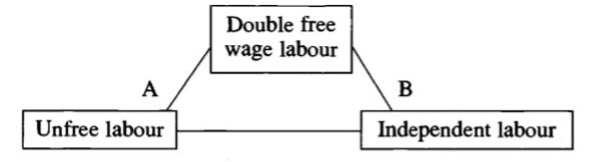
Historians Shahid Amin and Marcel van der Linden sketched this diagram depicting the ideal-type of “doubly free labor” prevalent in twentieth-century social science. This conception was not exclusively Marxist but accepted widely among Weberians and conservative social theorists as well, achieving a “broad consensus” for much of the last century.11
I do not doubt Marx saw doubly free labor as crucial for the emergence of capitalism. But it is valuable to pay attention to the reasoning why exactly free labor was significant for his conceptualization and, conversely, why it could be argued “unfree workers” should be excluded.
Brenner and Wood’s reasoning was clear enough. Their main objection was that because “unfree” workers were tied to property, masters, planters, and peasants could avoid confronting market incentives to raise productivity.12 It is not that plantations and farms could not produce commodities for the world market but that market pressures lacked the proper leverage to push them to invest in new technology. They instead reacted to falling prices by either withdrawing from the marketplace or simply squeezing workers more, a logic of super-exploitation laid out by A.V. Chayanov. Within this view, “capitalism” became synonymous with the development of productive forces. Put another way: industrialization became the litmus test for whether a society could be considered “capitalist.” It was a definition that turned on the question of technical efficiency, a quantitative measure of relative levels of productivity and the capacity of different techniques: I see this as a “technicist” interpretation of Marx’s Capital.13
This reading buttressed countless studies in the twentieth century that argued that capitalism had failed to emerge in regions without the spectacular processes of enclosure, urbanization, and mechanization, including France, China, south Asia, Latin America, the United States south, the Muslim world, Italy, the Netherlands — virtually anywhere else but England. What was originally posited as a theoretical model of capitalist transition became, in practice, one of non-transition. As Jan de Vries put it: “we have moved from Marxism — which explains how capitalism necessarily emerges from feudalism — to Brennerism — which explains how it can’t.”14
Contradictions with Global History
The methodological and historical contradictions of this model, however, emerged sharply in my own research on modern Asian history. The heart of Marx’s Capital was England’s mills for spinning and weaving cotton, wool, flax, and silk, which took for granted the presence of free workers. But throughout the text, Marx also made marginal references to the global market. The opening chapter on “the commodity” discussed not only coats and linens but also coffee from Brazil,15 gold from California,16 and tea from China, perhaps India. If sugar was the major commodity of the eighteenth century, and cotton the nineteenth, then the tea trades of China and India — as well as Japan, Taiwan, Ceylon, and the Dutch East Indies — represented Asia’s contribution to a burgeoning global division of labor.17
Since the 1700s, Chinese tea had traded for New World and east Asian silver, raw cotton, and Indian opium. Its demand grew in tandem with the production of Caribbean sugar for consumption across the north Atlantic. American merchants grew rich off of the opium and tea trades, especially in Boston, as did notable capitalists such as John Astor in New York City, or here, in Philadelphia, Stephen Girard. By the time of the publication of Capital — the 1860s — the Indian colonial government had also begun to promote large tea plantations in the newly-annexed northeast territory Assam, bordering Burma. Tea from Asia was a global commodity bound up with the classic industries animating the story of the rise of capitalism.
The theoretical problem is that the laboring conditions behind Chinese and Indian tea — and for most global commodities at this time — were decisively unfree by the standards of twentieth-century social science. In China, the plant was cultivated and roasted on independently-owned family farms, powered largely by women and children. The semi-processed leaves were purchased by itinerant brokers, commercial agents, and financiers, who refined them in temporary workshops near midsized market towns in the countryside. Workers consisted of seasonal and casual workers — men, women, old, and young — who were not propertyless but market-dependent smallholders supplementing their household income. They were, in short, one leg of the “free/unfree labor” pyramid above, the putatively independent proprietor.
In Assam, India, the colonial government teamed up with metropolitan capital to create large estates known as “tea gardens,” powered by migrant workers brought in through penal contracts. Established in the 1860s, the contracts amounted to an anachronistic regime of indenture, drawing on centuries-old “master and servant laws” that ran contrary to the global trend towards abolition. In theory, migrants from central and eastern India would sign up to work voluntarily. In practice, if they tried to leave the gardens, they were beaten and imprisoned with impunity. They represented the other leg of unfreedom, the immobilized indentured worker.
This picture presents a conceptual impasse. On the one hand, workers in the Asian tea trade did not fit the ideal-type of doubly free labor. On the other, they nevertheless produced commodities as part of a massive web of value spanning the globe. Where could the line between capitalism and non-capitalism be drawn? Could we say that the tea grown in Asia did not count as part of capitalist value, insofar as they were produced by peasants and contract labor? Did tea only count as part of capital when it reached consumers in proletarianized Euro-American societies?18
To address this question, I have found most useful Jairus Banaji’s close readings of Marx’s text, which he frames as a blend of Hegelian logic and historical thinking. Banaji argued that Marx’s Capital operated at multiple “levels of abstraction.” Yes, the Anglocentric story of “primitive accumulation” was plausible for several discrete historical moments, but England was only the “classic” case of a more expansive history.19 To fixate on expropriated workers as the only possible form of labor under capital was to conflate two levels of analysis in Marx: “forms of exploitation” versus “historical modes of production.”20
“Forms of exploitation” refers to the varied specific practices of extracting surplus from workers, most of which predated capitalism and were logically compatible with other societies. Aside from the market wage, historical examples include slavery, serfdom, corvée, debt bondage, and so on. Yes, for Marx, wage labor was capitalism’s primary form of exploitation. However, Marx also frequently described capitalism not only as a technical method of production but also a temporalizing and historical category. Throughout his drafts, especially in the Grundrisse, he used the “mode of production” concept interchangeably with phrases such as “eras,” “epochs,” and “epoch-making”; “forms of society” and “production”; “periods of production”; and “historic modes” and “historic organization of production.”21 The unit of analysis adequate for understanding capital, then, was not the individual farm but an entire epoch.
The Epoch-Making Commodity-Form: another story of transition
In my reading, there is one key instance of historicizing language in the first volume that helps guide us through Marx’s fuller views on the role played by doubly free labor. In chapter 6, he wrote:
The historical conditions of [capital’s] existence … arises only when the owner of the means of production and subsistence finds the free worker available, on the market, as the seller of his own labour-power. And this one historical pre-condition comprises a world’s history. Capital, therefore, announces from the outset a new epoch in the process of social production.22
Marx straightforwardly equated the “new epoch” of capital with free wage labor. However, crucially, the reasoning he gives here was entirely different from the technical explanation found in Dobb, Brenner, Wood, and others. Marx continued in the footnote at the bottom of page 274:
4. The capitalist epoch is therefore characterized by the fact that labour-power, in the eyes of the worker himself, takes on the form of a commodity which is his property; his labour consequently takes on the form of wage-labour. On the other hand, it is only from this moment that the commodity-form of the products of labour becomes universal.23
For Marx, the “capitalist era” or “epoch” is not distinguished by technical efficiency but by the universalization of the “commodity-form.” Perhaps the phrase is clear for some of you in the audience: the “commodity-form” after all is one of those specialized terms you encounter all the time in Marxist scholarship. But for myself, I was not sure what the phrase meant from an empirical perspective. How do you write a concrete history of the commodity-form and its emergence?
I found it useful to connect Marx’s first volume with the earlier drafts of Capital that were published only posthumously, in particular, selections from the second draft (1861-1863) and the section from the third draft (1863-1865) known as the “Results of the immediate production process,” or, “the Resultate.”24 In the latter, specifically, he elaborated on what he meant by the universalization of the commodity-form:
The transformation of money … into capital occurs only when a worker’s labour-power has been converted into a commodity for him. This implies that the category of trade has been extended to embrace a sphere from which it had previously been excluded or into which it had made only sporadic inroads. In other words the working population must have ceased either to be part of the objectiveconditions of labour, or to enter the market-place as the producer of commodities; instead of selling the products of its labour it must sell that labour itself, or more accurately, its labour-power. Only then can it be said that production has become the production of commoditiesthrough its entire length and breadth. Only then does all produce become commodity and the objective conditions of each and every sphere of production enter into it as commodities themselves. Only on the basis of capitalist production does the commodity actually become the universal elementary form of wealth.25
Marx was telling a story here. In earlier societies, households, estates, and plantations produced things for sale, such as crops, tools, and textiles, but those commodities were only the “excess produce” of what they made or grew for themselves. A peasant family, for instance, could cultivate wheat with fifty percent set aside for personal consumption and fifty percent for sale in the marketplace. For Marx, the sporadic production and sale of commodities in earlier commercial societies formed the “historical premiss of the capitalist mode of production.”
In the published first volume, Marx briefly referred to such independent and unfree producers as “hybrid forms” (Zwitterformen), and in his earlier drafts, “transitional forms” (Übergangsformen): that is, forms in which “the capital-relation does not yet exist formally, i.e. under which labour is already exploited by capital before … labour itself has taken on the form of wage labour.”26 Below, I will say more about how such pre-waged forms fit into Marx’s schema of subordination to capital.27 For now, it is worth pointing out that Marx’s emphasis in the main text was the ephemerality of these forms, that they would lead “inexorably to capitalist production” and how “capitalist production destroys the basis of [traditional] commodity production.”28
According to him, unfree and independent producers would, over time, be gradually pulled into selling increasingly more for the marketplace. This in itself still did not count as capital, strictly speaking, but only a transaction in money. The key distinction was not whether humans sell commodities at all but rather whether commodificationreaches into the production process itself, whether trade had “been extended to embrace a sphere from which it had previously been excluded.” This occurred only when land, materials, and labor — especially labor — became objects that could only be acquired via exchange as well. The “commodity-form” became the universal form of wealth only when everything that producers made — not just excess produce — became a commodity. And this occurred only after producers themselves became commodified, unable to produce for their own consumption because they now fully depended on the market for survival.
The evidence for this process’s completion was that “as capital develops, the general laws governing the commodity evolve in proportion.”29 What are those “general laws”? And if commodities are now the universal form of wealth, what other forms of wealth could they be contrasted against?
The answers to such questions were already given in the first chapter of Capital. As historians, we often gloss over chapter 1 as a primer on rudimentary economics. But it was also, implicitly, a historical argument about how capitalism took shape. Past societies had long used money, but the basis of who was wealthy and how much things cost was shaped by countless overt factors, from monopoly and land ownership to seasonal fluctuations to religion to state fiat to moral economy and so on. What distinguished the capitalist mode of production was a system of covertvalorization organized on the basis of commodity production. Such value was expressed through exchange-value, that is, as quantities of money, which ultimately were derived from the measurement, abstraction, and commensuration of the only ingredient shared in common by all commodities: the expenditure of human labor.30
In concrete historical terms, this was a story of how prices converged and settled upon values that reflected labor productivity. For instance, economic historians generally agree that before the 1800s, merchants engaged in the long-distance trade of silver, sugar, cotton, and opium, but prices were wildly divergent across space. In the 1700s, tea in England could be sold at ten times its Chinese purchase price. For international merchants, the basis of their profit was arbitrage, and there was little incentive to intervene into production. But over time, market forces intensified: more trading volume, faster turnover, fewer tariffs, and new transportation routes, all of which resulted in vanishing price differentials. By the nineteenth century, the price difference for tea had shrunk to 2.5 times, and by the twentieth, 1.5. Only then did producers feel the pressure to raise the efficiency of cultivation, manufacture, and delivery as a competitive strategy. In Marx’s notes on merchant capital, this pattern culminated in a sort of transition to industrial capitalism, wherein capital began to intervene into production, a transformation that has been substantiated by recent historical scholarship.31
Value under capitalism, then, is a determination of social averages, expressed through prices, which exert impersonal pressures to make things more quickly. Paradoxically, as humans work more productively, they lower the social average of their labor, diminishing the amount of value embodied in each commodity, in turn degrading their own status as producers. In Marx’s early example, power-looms in England rendered the finished goods of hand-loom weavers one-half their former value, even if the weavers’ physical capabilities remained unchanged.32 The chase for profits by increasing productivity has ultimately amounted to nothing more than running in place, what Moishe Postone memorably called “the treadmill effect” of the capitalist value-form.33 Marx called it capital’s “immanent drive.”34
This is what Marx meant by the “general laws governing the commodity” that evolved in proportion with capital. In his notes and drafts, he suggested that the logically tight system presented at the start of Capital had come into force only when everything had been converted into the form of the commodity. The final frontier, historically, was the commodification of labor itself.
As independent and unfree labor grew dependent on the market for survival, the qualitative use-values of the elements of the production — the sensuous, physical dimensions of raw materials, land, and human labor — were increasingly converted into quantitative exchange-values in the form of money, subjected to abstract calculations and the pressure of averages. In “the Resultate,” Marx described how even independent peasants could find themselves pulled into the spiral of value:
[T]o the extent to which agriculture produces for the market, i.e. produces commodities,articles for sale and not for its own immediate consumption - so too, and to the same degree, it calculates its costs, treats each item as a commodity (regardless of whether it buys it from another or from itself, i.e. from production).In other words, then, inasmuch as the commodity is treated as an autonomous exchange-value, it acts as money.Thus since wheat, hay, cattle, seed of all kinds, etc. are soldas commodities - and since without the sale they cannot be regarded as products - it follows that they enter production as commodities,i.e. as money. Like the products,and as their ingredients,the conditions of productionare indeed themselves products and they too are thus reduced to commodities.And as a consequence of the valorization process they are included in the calculations as sums of money,i.e. in the autonomous form of exchange-value.35
Similarly, in chapter 10 of Capital, Marx argued that when slavery began to produce for the world market, it too became subjected to the pressures of valorization and calculation:
But as soon as peoples whose production still moves within the lower forms of slave-labour, the corvée, etc. are drawn into a world market dominated by the capitalist mode of production, whereby the sale of their products for export develops into their principal interest, the civilized horrors of overwork are grafted onto the barbaric horrors of slavery, serfdom etc. Hence the Negro labour in the southern states of the American Union preserved a moderately patriarchal character as long as production was chiefly directed to the satisfaction of immediate local requirements. But in proportion as the export of cotton became of vital interest to those states, the over-working of the Negro, and sometimes the consumption of his life in seven years of labour, became a factor in a calculated and calculating system.36
There is plenty of new research to corroborate such analysis, even though — or precisely because — it does not come from doctrinaire Marxists. For instance, what made US slavery capitalist was not its relative efficiency. Economist Gavin Wright has argued it was inefficient compared to free labor even at the time, contributing to the underdevelopment of the south. Instead, it was that slavery, per Marx, had entered into a “calculated and calculating system.” Caitlin Rosenthal has thus demonstrated how nineteenth-century cotton cultivation was gradually captured by trends towards Taylorist rationalization. Similarly for domestic labor, de Vries has shown that market-oriented work performed by women and children increased among early modern European households, in sectors such as agriculture, textiles, metallurgy, leather, wood, and ceramics. They calculated their earnings rationally, not as communal units but as individuals on the marketplace. The family unit long predated capitalism, but by “the seventeenth century wage labor was the single most important source of money in much of northwestern Europe ... [I]n this context individual labor rather than the collective labor of the family was the prevailing pattern.”37
To reiterate: Marx did indeed posit that doubly free, commodified labor was an epoch-making development in the history of capitalism, as argued by generations of scholars such as Dobb, Brenner, and Wood, but notbecause it was technically superior to unfree labor. Such reasoning may be relevant for a secondary discussion about productivity and innovation, of absolute versus relative surplus-value. But the economic superiority of free labor was an argument established long before Marx’s time, widespread in a nineteenth-century abolitionist literature that took its cues from seventeenth-century political economy.38 It was an argument perfectly concordant with mainstream political economy, as opposed to Marx’s intended critique of political economy.39
Marx’s contribution instead was to historically ground the naturalized assumptions of economic thought. The comparison between free and unfree labor rested upon the ahistorical presupposition that increased labor productivity was a natural goal of human behavior, owing to Malthusian land and resource shortages (use-value). By contrast, for Marx the pressures towards rising productivity under capitalism were historically distinctive, owing to the socially-generated pressures of a commodity-form that abstracted and commensurated labor into calculable exchange-values. Marx’s theory of the commodity-form, in other words, could historically account for what was only taken for granted in the mainstream story of technical efficiency pursued by Dobb, Brenner, and Wood.40
Really, Marx’s theory of transition was an inverted version of that Anglocentric account. It was not that the property relations of individual producers mechanistically triggered a chain of events culminating in industrialization. Instead, Marx emphasized that individual producers were absorbed into something bigger than themselves — namely, the abstract dynamics of commodification and, by extension, its spiral of valorization and calculation. As Diane Elson put it: “Marx’s argument is not that the abstract aspect of labour is the product of capitalist social relations, but that the latter are characterised by the dominance of the abstract aspects over other aspects of labour.”41 Consequently, I believe Marx was more interested in a story wherein the historical subject was not the producing or working classes, as it was for Dobb, Brenner, and Wood, but capitalist value itself. The transition to capitalism was really the universalization and realization of the commodity-form, and hence of value, as the “dominant subject” (übergreifendes Subjekt) of the historical process.42
Universality and Generality
The account of transition found in the margins of Capital differs from mainstream Anglocentric accounts, yet it still privileges doubly free labor as a linchpin for capitalism’s emergence. However, because the unit of analysis was not the individual producer but an entire epoch, it was more open-ended and accommodating of a variety of social arrangements. Many of the above-quoted passages on slavery and independent proprietorship indicate that Marx did not see the transition as an overnight, all-or-nothing proposition but a gradual, iterated process. Phrases such as “to the extent,” “to the same degree,” “inasmuch as,” “in proportion as,” and “evolve in proportion” — these suggest that even without becoming doubly free, producers were already contributing to the global expansion of value in Marx’s time.
The early second draft of Capital (1863) provided the most extended commentary on pre-waged “transitional forms” I have come across. He provided the concrete examples of “self-sustaining peasants,” such as the Indian raiyat or the Roman plebeians, and of “domestic industry,” such as English stocking weavers, all of whom were “formally free” to bargain with moneylenders and merchants without being directly subordinated. Yet in spite of their non-commodified status, their surplus produce appropriated in the form of interest or arbitrage still contributed to the “total surplus value” pocketed by circulating capital.43 Along similar lines, Marx elsewhere described American slavery or the Danubian corvée as unfree institutions whose aim was not the production of “useful products” but “of surplus-value itself.”44
That it was possible for independent, unfree workers to produce capitalist value is perhaps uncontroversial by now. But that is not the same as arguing that slavery and peasantry were inherently capitalist in the same way as Marx viewed the free waged worker. Questions of mediation still persist. How do we include “transitional forms” within a theory of capitalism without collapsing the historical and technical differences with free labor? And what does it mean for the free worker to play a leading, epochal role in capitalism’s story, if capitalism can still accommodate counterparts who are decidedly unfree?
To address such questions, I found it most useful to probe the concept of “universality” that appears throughout the passages above. Notably, what was translated into English as “universal” is the German allgemeine. The same term was also frequently translated as “general,” and both were used throughout the different drafts, almost interchangeably. For instance, on the same page as the “Resultate” passage above, wherein Marx’s words were translated as “the universal elementary form of wealth” [die allgemeine elementarische Form des Reichtums], he continued:
(2) The production of commodities leads inexorably to capitalist production, once the worker has ceased to be a part of the conditions of production (as in slavery, serfdom), or once primitive common ownership has ceased to be the basis of society (India). In short, from the moment when labour-power [itself] in general becomes a commodity [die Arbeitskraft selbst allgemein zur Ware wird].45
In other words: the emergence of capitalism depended upon not only the universalization/generalization of the commodity-form but also of free labor. How do we understand Marx’s deployment of the term allgemeine in these lines?
My own take is this: Marx adopted a specific meaning of allgemeine that was indebted to Hegel’s own conception of the universal and the particular, or, das Allgemineand das Besondere. In the Encyclopaedia Logic (1830 edition), Hegel warned that the “universal” should notbe viewed as a flat abstraction, in which everything was presumed to share the same traits in common. For Hegel, this vulgar understanding of universality [das Allgemeine, das Universelle] was really “commonality” [das Gemeinschaftliche]. In this vulgar version, in order to derive a universal conception of a flower, for instance, you would need to abstract it away from, and thereby omit, all particular differences, ignoring the qualities of being purple or yellow or red flowers, short or tall flowers, and so on. A vulgar, abstract universality simply retains the bare minimum of what is shared in common. For Hegel, “such concepts are hollow and empty, ... they are mere schemata and shadows.”
Instead,
What is universal about the Concept is indeed not just some thing common against which the particular stands on its own; instead the universal is what particularises (specifies) itself [selbst Besondernde (Specificirende)], remaining at home with itself in its other, in unclouded clarity.46
A truly universal concept of the flower would not be opposed to the particular purple and yellow flower. Instead, it manifests itself through purple, yellow, and all different varieties of flowers. True universality encompasses both what is held in common but also what is particular to each specific instantiation.
Now compare these lines from Hegel to what Marx wrote in the famous 1857 introduction, published in the Grundrisse:
In all forms of society there is one specific kind of production which predominates over the rest, whose relations thus assign rank and influence to the others. It is a general illumination [eine allgemeine Beleuchtung] which bathes all the other colours and modifies their particularity [Besonderheit]. It is a particular ether which determines the specific gravity of every being which has materialized within it.47
Marx’s notion of “universality” and “generality,” in other words, was more complex than “commonality,” the vulgar, abstract statement that “all capitalist labor must be free wage labor or else it is not capitalist.” Rather, Marx saw free wage-labor as a general relation that embodied and crystallized the logic of labor as an alienable commodity. In pre-bourgeois modes of production, wage labor counted as one particular, but not universal, social relation. Within the “capitalist epoch,” wage labor has become the “general/universal illumination” that historically takes on, or “particularises itself” in, myriad concrete forms. If, for Hegel, the universal flower manifests as lavenders and marigolds, then for Marx, the essential relation of purchasing and selling labor for commodity production could subsume not just waged work but a variety of exploitative forms, from slavery and indenture to communal agriculture. He agreed with other political economists that a truly atomized proletarian workforce enjoyed technical advantages over independent and unfree workers — it was more “variable,” “versatile,” “flexible,” and “intense” — but the latter could still assume the same social form beneath concrete differences. In some cases, they were even preferable for capital.48
Of course, Marx criticized Hegel’s categories for being idealist, that Hegel believed the universal concept in the mind preceded particularity in the external world. Marx’s universality, by contrast, was not a philosophical premise but the product of history. What had become universal in capitalism — the commodity-form and wage labor — were the results of social and economic forces operating in discrete moments in time. It was only on the basis of material processes that they could “bathe and modify” the non-specifically capitalist, “available, established labour processes” that preceded the capitalist era.49 What this process entailed, I believe, was capitalist competition expressed through falling prices and increased market dependence for reproduction. In the same passage from the 1857 introduction, he speculatively outlined how industrial capital had subsumed older forms of production, such as agriculture, and subordinated them into a “branch” of its wider circuit.50
It should be stressed that although Marx believed slavery and household labor could be integrated into the “universality” of the commodity-form, he was notarguing that such antecedent forms could constitute the basis of the capitalist era. Arguments that flirt with these conclusions have circulated for a while, from world-systems theory in the 1970s to more recent scholarship on racial capitalism, social reproduction theory, and, most notably, the new histories of US capitalism.
To define and equate capital with unfree labor, as many new works have suggested, invites broader historical and logical questions, most obviously, what about earlier societies that had slavery but no capitalist accumulation? From the perspective of Marx’s theories, this equation loses touch with the specificity of labor as a commodity and, by extension, with the dynamic of value at the heart of capital’s logic. We should be able to distinguish between two different types of inquiry. The new literature on racial capitalism is primarily focused on the question of American slavery — how it has been understood in the past versus today? could it be classified as modern? — and its authors have looked to the capitalism debates to help settle questions of national historiography. Such inquiries provide significant interventions into the study of US society, but they often wind up framing capitalism in binary terms — is it or not? — flattening different trajectories of accumulation. The question of slavery, ultimately, is different from asking how to grasp capitalism itself as a totality: what are its fundamental dynamics, how can it be historically disaggregated, and where can we locate slavery and domestic labor within a broader circuit wherein wages predominate as the “general illumination”?51
I believe we can be more precise. At the same time we expand our conceptualization of capitalism, we can also guard against collapsing all differences between forms of exploitation. The key, missing distinction in much of the new literature, I believe, was one that Marx drew between the “specifically capitalist” forms of production that were only historically imaginable with wage labor — such as Victorian cotton mills or Michigan car factories — versus the “inherited, available labour processes” that capital took over from extant social formations, namely, slavery, serfdom, and peasantry.52 Such exploitative forms were not specifically capitalist, but their content — their fundamental essence — could be transformed once integrated into global competition, animated by the generalization of wage labor.
This conceptualization of wage labor is, admittedly, more abstract than the straightforward story of primitive accumulation and English enclosures in most economic histories. But abstraction is, after all, the defining quality of labor under capitalism. For scholars studying the rest of the world, in fact, this abstraction and flexibility prove especially useful for triangulating between Marx’s theoretical work and the concrete world histories that were never directly analyzed in his text.
In my own research on Asia, I discovered plenty of examples of managers and merchants in China and colonial India attempting to measure, calculate, and raise the productivity of their casual, seasonal, indentured workforces. World tea prices began to plateau and fall off from the 1860s onwards, and capitalists understood that in order to remain competitive they needed the edge of efficient production. They used seemingly archaic methods but aimed them towards the modern goals of competitive accumulation.
In colonial India, British planters tortured workers, often beating them to death, in order to keep them on task and meet production goals. Several stated that they had raised productivity by 25-30%. One wrote, “tasks for hoeing and plucking have in 10 years increased by one-fifth.” Another claimed the industry was “endeavouring by every possible means to reduce expenditure” by “taxing to the utmost the working power of the coolies.” And in a lecture delivered by a British doctor, later excerpted and circulated in a report to the Qing’s Guangxu Emperor, he proclaimed: the “command of the Tea supply . . . will finally rest with whatever country can produce it at least cost, a law that applies to all commodities.”53 These were the same “general laws” of the commodity identified by Marx as the basis of the capitalist epoch, now shaping putatively traditional work patterns across Asia.
The most memorable example came from stories of tea production in southern Anhui, China. In handbooks and surveys from the region, we find evidence that merchants hired workshop managers who oversaw tea roasting, rolling, and drying by keeping close track of time. They did not have precise mechanical clocks. Instead, they tracked time based on a peculiar instrument: slow-burning incense sticks, typically found used in temples and religious rituals. The principle was similar to an hourglass: rather than abstract numbers, such as ten minutes or two hours, they offered the basic promise that each stick would burn for roughly the same amount of time (about forty minutes), providing a baseline for comparison and averages. Managers created precise instructions by timing each task of production and coordinating them into a division of labor: fire the leaves for the duration of 2.5 to three sticks of incense, stir the leaves for eighty percent of one stick, then rotate and press the leaves for half of a stick of incense, and so on. Eventually, managers created wage and reward system tied to productivity: if workers completed tasks faster than average, they would be paid more; slower than average, they would be paid less.54
The incense system is especially illustrative of capitalism’s unevenness. It is hard to imagine a kind of industrial technology that appears more physically primitive, traditional, or premodern — and yet it was still bound up with the abstract patterns of value. Contra the Brenner theory, managers and workers in a putatively traditional industry felt and responded to social pressures that were very much modern and shared in common across the industrial world.
Conclusion: Transitions within the History of Capital
To restate my argument: we should maintain the distinction between two different moments of transition in Marx’s Capital.The first is the generalization of the commodity-form and of wage labor, which entails many specific, particular variations on the general form of doubly free labor. This was described by Marx as the emergence of “transitional forms” or the “formal subsumption” to capital. The second is the subsequent passage from absolute to relative surplus-value, or from formal to real subsumption, with the latter emerging upon the basis of the former. It entailed revolutions in the production process, such as from handicraft to industry to, these days, factories with minimal human labor inputs. In 2020, for instance, Taiwan-based Apple supplier Foxconn announced it would convert its own facilities into “lighthouse” factories, which would lead the way towards an industrial future driven by automation and artificial intelligence, expelling labor from the production process.55
Again, though debates over capitalism’s origins over four centuries ago may appear irrelevant to us today, they actually pivot on substantive questions about what capitalism means in our own time. The Anglocentric model assumed that capitalism could be limited to one enterprise or one country and that capitalism really only began with industrialization, or the moment of relative surplus-value. This analysis privileged the site of production as metonymical for accumulation as a whole, uncritically carved into national units. But that picture becomes more complicated once we relate production back to the overall circuit of value.
First, by prioritizing an analysis of the commodity-form, we can also account for the dynamics underlying that coveted process of industrialization central to twentieth-century development. Marx wrote that real subsumption always proceeded from the basis of an earlier formal subsumption:
[C]apital subsumes the labour process as it finds it, that is to say, it takes over an existing labour process, developed by different and more archaic modes of production.... If changes occur in these traditional established labour processesafter their takeover by capital, these are nothing but the gradual consequences of that subsumption.56
Whereas past scholarship, such as the Dobb, Brenner, and Wood tradition, fixated on revolutions in the production process, Marx himself believed there was a greater degree of continuity between formal and real subsumption, absolute and relative surplus-value. I do not see this relationship as a teleological stage theory, wherein the former must lead to the latter, but a logical relationship in which the former represents the conditions of possibility for the latter without necessarily getting there. There is a strong tradition in the history of technology and science that similarly suggests it was the gradual transformations in labor intensification (absolute relative-surplus value) that subsequently laid the groundwork for capital-intensive, labor-substituting technology (relative surplus-value).57 To cut off the latter from the former is a reification of history, unmooring it from any concrete analysis of changes over time.
Second, by foregrounding the commodity-form, we can see clearly why a research agenda exclusively fixated on relative surplus-value is logically at odds with a broader analysis of capitalist value. In that first chapter, Marx lays out how “value” is determined based upon social averages, one that presupposes a diversity of producers with different levels of efficiency. Relative surplus-value is “relative” to other forms of exploitation, and its coherence depends upon co-existence with absolute surplus-value.
As Marx pointed out, if value were simply a straightforward measure of labor expenditure, as Smith and Ricardo posited, then that system would actually disincentivize innovation. Someone who learns how to produce textiles with power-looms using one-half the labor of their peers would wind up impoverished, for they would have to sell their goods at half the price. But in reality the first power loom-made goods were sold at the same price as handwoven ones, and they earned monopoly surplus profits because of lower productions costs. This is the significance of Marx’s observation that value operated through averages. Exploitation really takes place in two separate moments: first extracted from labor itself, and then from less to more productive producers. Relative surplus-value feeds upon absolute surplus-value as the source of its super-profits. Thus, if we were to exclude absolute surplus-value from our mental map of capitalist production — if we were to say that the only producers who count as capitalist are those using the most cutting-edge techniques — then there would be no relative surplus-value to be found, and the value concept becomes incoherent.58
In short, past Marxist scholars who fixated on the site of production envisioned a global economy composed of a patchwork of capitalist and non-capitalist producers, of local “transitions” and “non-transitions” to capitalism. In the nineteenth century, hypothetically, the British waged economy may have been capitalist but the suppliers of their sugar, tea, raw cotton, and other consumer goods and materials remained non-capitalist. The logical and historical problems that arise from this conception should be plainly visible. Instead, it is more useful to read Marx as positing one fundamental epochal transformation, which he called at various moments “the capitalist mode of production” or “capitalist era” or “capitalist epoch.” He described this transition conceptually. In terms of real history, he speculated that it began several centuries ago and has since become global in scale. It has also been characterized by unevenness, or the impersonal dynamics of many capitals in contention with one another.
For those of us studying the last two centuries, my guess is that many of the “transitions” we are attempting to theorize are transitions not tocapitalism but from within capitalism’s history — namely, from absolute to relative surplus-value, or, from inherited processes (slavery and family farms) to novel ones overhauled and restructured in capital’s image (industrial plantations and Fordist factories).
Back in the present, we should bear in mind that the second transformation — from workshop to factory — is ongoing and sporadic and never exhaustive of economic life, prone to reversal. For every example of high-tech automation, we hear about archaic forms of subcontracted, unfree gig labor. In fact, during the widespread protests against China’s “zero-Covid” policies in late 2022, workers in Zhengzhou’s Foxconn facilities — the same company touting its smart “lighthouse” factories —had to literally scale physical walls in order to escape their employer and return home, demonstrating a mixture of anachronistic, unfree conditions within the most putatively cutting-edge industries (not to mention recent allegations of child slavery).59
In the past few decades, confidence in the teleology of industrialization has been undermined, and among historians the Anglocentric model that fetishized large-scale industry appears increasingly provincial. Patterns of deindustrialization and globalization suggest that capital technologies can sometimes be replaced by strategies that are labor-intensive, geographically dispersed, and responsive to a volatile international market. As David Harvey put it, capital-intensive “rigidity” became a burden while labor-intensive “flexibility” a virtue.60
My pet theory is that 1973 marks the turning point in the reimagination of Marx’s work, both within the academy and outside. On the one hand, the English publication of the Grundrisse brought to the surface the historical and Hegelian structure of Marx’s logic. On the other, the 1973 oil embargo punctuated the global stagflation crisis, casting doubt upon the power and centrality of north Atlantic industry while refocusing attention on “capitalism” as a historically determinate, crisis-prone phenomenon. New practices have emerged — from financial deregulation to labor offshoring to hyper-consumption — that have made obvious the connected yet uneven character of global capital.
Central to all of this was not only the so-called crisis of western capitalism but also the emergence of newly-industrialized countries, especially in Asia, as the new epicenters of global manufacture. From the 1960s onwards, Asia has witnessed a series of unprecedented national economic “miracles,” from Japan to South Korea to China. None of that history makes any sense if we assume that such countries had been immune to capitalist dynamics in previous centuries, as was once assumed. Instead, these stories, from postwar Japan to China’s 1980s reform and opening, are more legible as the culmination of a longer integration into the global division of labor.61
On the one hand, novel transformations in our time are shedding new light on histories in the distant past that we thought were fully understood. On the other, as scholars continue to write new histories of capitalism — ones that highlight unfree and domestic labor, finance and merchant capital — these can also inform the way we understand the present, as the latest moment within the by-now centuries-long epoch of capital.
- Acknowledgments: Thanks to Ericka Beckman and the audience at the Marxist Literary Group Institute for Culture and Society; to Colleen Lye, Lindsay Choi, Alex Walton, and the UC-Berkeley Interdisciplinary Marxism Working Group; and Jairus Banaji and Ben Parker for their valuable suggestions.
- See Andrew B. Liu, “Notes Toward a More Global History of Capitalism: Reading Marx’s Capital in India and China” Spectre (2020), https://spectrejournal.com/notes-toward-a-more-global-history-of-capitalism; Andrew B. Liu, “Production, Circulation, and Accumulation: The Historiographies of Capitalism in China and South Asia” The Journal of Asian Studies, 78.4 (2019) 767–788; Andrew B. Liu, “From the Great Divergence to New Histories of Capitalism,” Global Economic History,eds. Giorgio Riello and Tirthankar Roy, second edition (London: Bloomsbury, 2024): 147-163; Andrew B Liu, “Levels of Abstraction? Jairus Banaji’s Method and a Reconsideration of Chinese Merchant Capital.” Storica 83-84 (2022) 211–26.
- My thinking is most indebted to the work of Mumbai-based writer Jairus Banaji, especially Banaji, “Modes of Production in a Materialist Conception of History (1977)” in Theory as History: Essays on Modes of Production and Exploitation (Chicago: Haymarket Books, 2011) 45–102; see also my conversation with Banaji and fellow historian Sheetal Chhabria: “‘Where is the Working Class? It’s All Over the World Today’: Jairus Banaji in Conversation with Sheetal Chhabria and Andrew Liu” Borderlines, companion site to Comparative Studies in South Asia and Middle East (2020), https://www.borderlines-cssaame.org/posts/2021/1/18/part-ii-where-is-the-working-class-its-all-over-the-world-today. Other influential interlocutors include Harry D. Harootunian, Rebecca Karl, Moishe Postone, and Andrew Sartori.
- The following section is a restatement of arguments from Liu, “Production, Circulation, and Accumulation.”
- Robert Brenner, “The Origins of Capitalist Development: A Critique of Neo-Smithian Marxism” New Left Review I/104 (1977) 25–92; T. H. Aston and C. H. E. Philpin, eds., The Brenner Debate: Agrarian Class Structure and Economic Development in Pre-industrial Europe (Cambridge: Cambridge University Press, 1985); Immanuel Wallerstein, “The West, Capitalism, and the Modern World-System” Review, 15.4 (1992) 561–619; Ellen M. Wood, The Origin of Capitalism: A Longer View (London: Verso, 1999/2002)chap. 5.
- On the canonization of England as the archetypal capitalism success story, see David Cannadine, “The Present and the Past in the English Industrial Revolution 1880-1980” Past & Present 103 (1984) 131–172.
- Banaji, “Modes of Production: A Synthesis” in Banaji 2011 356-358.
- Karl Marx, Capital: A Critique of Political Economy, Vol. I (1867) Trans. Ben Fowkes (New York: Penguin Books, 1976) 876, emphasis added.
- Marx, Capital vol. 1 271-272. Emphasis added.
- Marx, Capital vol. 1 873. Emphasis added.
- Shahid Amin and Marcel van der Linden, eds., “Introduction” in “Peripheral” Labour?: Studies in the History of Partial Proletarianization (Cambridge: Cambridge University Press, 1997) 1–3.
- Brenner, “The Origins of Capitalist Development” 36.
- Liu, Tea War 14.
- De Vries quoted in Neil Davidson, How Revolutionary were the Bourgeois Revolutions? (Chicago: Haymarket Books, 2012) 410-411.
- Steven Topik, “The World Coffee Market in the Eighteenth And Nineteenth Centuries, from Colonial To National Regimes” (presented at the GEHN Conference, Bankside, London, London: London School of Economics, 2004) https://www.lse.ac.uk/Economic-History/Assets/Documents/Research/GEHN/GEHNWP04ST.pdf
- Mae M. Ngai, The Chinese Question: the Gold Rushes and Global Politics (New York: W. W. Norton & Company, Inc, 2021) “Introduction.”
- On sugar, see Sidney W. Mintz, Sweetness and Power: The Place of Sugar in Modern History (New York: Viking, 1985); on cotton, see Sven Beckert, Empire of Cotton: a Global History (New York: Alfred A. Knopf, 2014).
- Similar questions have also been debated for regions closer to the center of capitalism’s historiography, such as the slave plantations of the Atlantic (see Mintz, chap. 2) or the small, independent farms of France and Germany investigated in Karl Kautsky’s The Agrarian Question (1899).
- Marx, Capital vol. 1 874.
- Banaji, “Modes of Production” 52.
- Banaji, “Modes of Production” 51-52; Karl Marx, Grundrisse: Foundations of the Critique of Political Economy, Trans. Martin Nicolaus (New York: Random House, 1973) 98-107.
- Marx, Capital vol. 1 274.
- Marx, Capital vol. 1 274, fn 4.
- The draft scheme comes from Enrique Dussel, “The Four Drafts of Capital: Toward a New Interpretation of the Dialectical Thought of Marx,” Rethinking Marxism 13(1) (2001) 12-20. English versions of the second draft can be found scattered across the Marx-Engels Collected Works, and in particular, I found volume 34 most useful. “The Resultate” was planned as a bridge between the first two volumes and was intended to provide a theoretical summary of the argument in the first volume. It was first published in English as part of the 1976 Penguin edition. Comparing the two, one finds clear points of both overlap and divergence in the wording of the drafts, the exact contours of which I am unclear about.
- Marx, Capital vol. 1 950-951.
- Marx, Capital vol. 1 645; Friedrich Engels and Karl Marx, Collected Works, vol. 34 (New York: International Publishers, 1994) 117. In “the Resultate” translation, Marx describes these as “transitional sub-forms.” Marx, Capital vol. 1 1023.
- Such “hybrid” and “transitional forms” should be understood in relation to the more well-known opposition between the “formal subsumption of labour under capital” that was logically prior to a “real subsumption” by capital. Formal subsumption meant formerly independent workers were now employed under waged, capitalist conditions, on the one hand, but without the technological revolutions associated with capitalist development on the other, pointing to earlier phases of capitalism’s history prior to large-scale industry (Marx, Capital vol. 1 645). But even formal subsumption presupposed a free waged workforce, excluding slavery or independent smallholding. The “hybrid” and “transitional” forms constituted a kind “pre-formal” subsumption, in which workers were not even directly subordinated or employed by capital yet their surplus produce could still be appropriated as value-embodying commodities. Notably, one of the most famous explorations of the “formal subsumption” category was Banaji’s early essay on the cotton-growing peasantry of the Deccan Plateau, India, in which he is commonly understood to be arguing that highly indebted peasantry embodied Marx’s category of “formal subsumption.” But really, as I’ve laid out here, Marx would have likely counted them as part of the pre-subsumption categories of “hybrid” or “transitional” forms of independent labor. It is to Banaji’s immense credit that he was clear about this distinction even in the original essay, noting that his materials were really pointing to a case of “a ‘preformal’ subordination of labour to capital.” Banaji, “Capitalist Domination and the Small Peasantry: The Deccan Districts in the Late Nineenth Century (1977)” in Theory as History 282.
- Marx, Capital vol. 1 951.
- Marx, Capital vol. 1 950. Emphasis added.
- Marx, Capital vol. 1 125-131.
- Liu, Tea War 39; Karl Marx, Capital: A Critique of Political Economy, Vol. III (1894) Trans. David Fernbach (New York: Penguin Books, 1981) 444: “In the context of capitalist production, commercial capital is demoted from its earlier separate existence, to become a particular moment of capital investment in general, and the equalization of profits reduces its profit rate to the general average. It now functions simply as the agent of productive capital.”
- Marx, Capital vol. 1 129.
- Moishe Postone, Time, Labor, and Social Domination: A Reinterpretation of Marx’s Critical Theory (Cambridge: Cambridge University Press, 1993) 289.
- Marx, Capital vol. 1 436-437.
- Marx, Capital vol. 1 952. Further comments on how independent farmers could be subsumed to capitalist calculation can be found in his unpublished second draft (1863): “In feudal society,… relations which are far from belonging to the essence of feudalism also take on a feudal expression … It is exactly the same with the capitalist mode of production. The independent peasant or handicraftsman is cut into two … “As owner of the means of production he is a capitalist, as worker he is his own wage labourer. He therefore pays himself his wages as a capitalist and draws his profit from his capital, i.e. he exploits himself as wage labourer and pays himself in surplus value the tribute labour owes to capital.” (Engels and Marx, Collected Works, vol. 34 141-142.
- Marx, Capital vol. 1 345.
- Gavin Wright, “Slavery and Anglo-American Capitalism Revisited,” Economic History Review 73/2 (2020) 370-372; Caitlin Rosenthal, Accounting for Slavery: Masters and Management (Cambridge: Harvard University Press, 2018) chap. 3; Jan De Vries, The Industrious Revolution: Consumer Behavior and the Household Economy, 1650 to the Present (Cambridge: Cambridge University Press, 2008) 82, 102.
- Thomas Holt, The Problem of Freedom: Race, Labor, and Politics in Jamaica and Great Britain, 1832-1938 (Baltimore: Johns Hopkins Press, 1992) 24, 34; the most famous comparison between enslaved and free labor is found in Adam Smith’s Wealth of Nations (New York: Modern Library, 1776/2000), Book 1, chap. 8, “Of the wages of labour” 91-93.
- There is a long tradition of Marxist scholars who confused Marx for a liberal champion of free labor, overlooking his biting, ironic commentary on the concept of free labor. See Banaji, “Fictions of Free Labour,” in Theory as History.
- For the argument that Marx’s theory of value provides an account of the historically determinate directional dynamic of modern history, see Postone, Time, Labor 287-291. A major lacuna of the Brenner/Wood theory is an explanation for why propertyless workers and capitalist farmers should fight to raise their labor productivity as a result of total market dependence. There are general comments about producing more in order to profit in a competitive marketplace, but they do not indicate why it would not be possible to simply profit at the same level of productivity. There is no account for why prices should fall. Implicitly, they wind up relying upon a market-based theory of supply-and-demand to explain falling prices, as indicated by Brenner’s more recent works on the 20th-century downturn. Conspicuously absent is a theory of value that is animated by averages of labor-time central to Marx’s theory. While supply-and-demand theories are compatible with a theory of value, they are also non-specific to capitalism and are not directly tied to questions of productivity, e.g., they could just as easily apply to mechanization as they could to natural disasters. In Postone’s words, such theories capture the “surface” level of capitalism (circulation) without delving into its “deep structure” (production and labor). See Moishe Postone, “Theorizing the Contemporary World: Robert Brenner, Giovanni Arrighi, David Harvey,” in Political Economy and Global Capitalism: The 21st Century, Present and Future, ed. Robert Albritton, Bob Jessop, and Richard Westra (London: Anthem Press, 2010) 7–24.
- Diane Elson, “The Value Theory of Labour,” in Value: The Representation of Labour Under Capitalism (London: Verso Books, 1979/2015) 150. Further, as Banaji pointed out, Marx considered “wage labour … in the strict economic sense” as any activity that is “capital-positing, capital-producing labour.” Marx, Grundrisse 463, quoted in Banaji, “Modes of Production” 54. Put another way, capitalist labor is any form of labor (L) that has been brought into the circuit of valorization mapped out by Marx, as in this representation from the second volume of Capital: Karl Marx, Capital: A Critique of Political Economy, Vol. II (1884), Trans. David Fernbach (New York: Penguin Books, 1978) 124.

Equation showing M minus C, branching off into L and mp, then three dots, then P, then three dots, then (C+c)-(M+m) - Marx 1976, 255. See also Postone, chap. 2. It is worth pointing out, as well, that at times Marx will argue not that wage-labor creates capitalism but that capital “produces and reproduces the capital-relation itself; on the one hand the capitalist, on the other the wage-laborer” (Marx, Capital 724). Thanks to Ben Parker for the reference. [[IMAGE CODE HERE]]
- Engels and Marx, Collected Works 118-119; the section on “transitional forms” spans 117-121.
- Marx, Capital vol. 1 345.
- Marx, Capital vol. 1 951. Translation modified. Emphasis added.
- G.W.F. Hegel, The Encyclopaedia Logic (1830), Trans. T.F. Geraets, W.A. Suchting, and H.S. Harris (Indianapolis: Hackett Publishing Company, 1991) 240, §163 add. 1. Another way to read Hegel’s concept of universality/generality within Marx is Marx’s conception of the “world market” as the conclusion of his unfinished analysis, “in which production is posited as a totality together with all its moments, but within which, at the same time, all contradictions come into play” (Marx, Grundrisse 227). Thanks to Jairus Banaji for this reference.
- Marx, Grundrisse 106-107.
- Marx, Capital vol. 1 1031-1034. Marx was influenced by the works of the Scottish thinker James Steuart, English political economist T.R. Edmonds, and especially the Irish scholar J.E. Cairnes’s The Slave Power (1862). Cf. Engels and Marx, Collected Works 102-104. It would be fascinating for researchers to delve further into how Marx came to understand American slavery compared to English wage labor in his time.
- Marx, Capital vol. 1 1021.
- Marx, Grundrisse 107.
- I have discussed such questions with more depth in Liu, “From the Great Divergence.” See also Steven Hahn, “The Arch of Injustice,” Public Books (2021), https://www.publicbooks.org/the-arch-of-injustice
- Marx, Capital vol. 1 1021.
- Liu, Tea War chaps 4 and 5.
- Liu, Tea War chap 2.
- “Hon Hai to Add 20 ‘Lighthouse’ Factories,” Taipei Times, September 27, 2021, https://www.taipeitimes.com/News/biz/archives/2021/09/27/2003765055
- Marx, Capital vol. 1 1021.
- See Harry Braverman, Labor and Monopoly Capital: The Degradation of Work in the Twentieth Century (New York: Monthly Review Press, 1974/1998). At the same time, the transition to relative surplus-value is uneven and encounters barriers across many industries. In some cases, material circumstances prevent mechanization, such as the natural traits of crops like rice or tea. In other cases, as in service work, the labor being performed relies upon skills that cannot be quantified or objectified. A total analysis would bring both labor and capital-intensive industries together and study their interactions across labor markets and overall rates of profitability. One recent example is Jason Smith, Smart Machines and Service Work: Automation in an Age of Stagnation(London: Reaktion Books, 2020).
- This contradiction — that the logic of competition winds up canceling out labor, and hence the basis of value, from production — was, after all, the foundation for Marx’s theory of the falling rate of profit.
- Eli Friedman, “Escape from the Closed Loop,” Boston Review, November 28, 2022, https://www.bostonreview.net/articles/escape-from-the-closed-loop. On child slavery in Foxconn, see Yuan Yang, “He Blew the Whistle on Amazon. He’s Still Paying the Price,” Financial Times, December 7, 2023, https://www.ft.com/content/de5fea12-2938-4c20-b394-10ca258a5fa1
- David Harvey, The Condition of Postmodernity: An Enquiry into the Origins of Cultural Change (Cambridge, MA: Blackwell, 1989) chap. 9.
- One useful take on Chinese history is “Red Dust,” Chuang, no. 2 (Glasgow: Bell & Bain, 2019), 21–281. https://chuangcn.org/journal/two/red-dust
